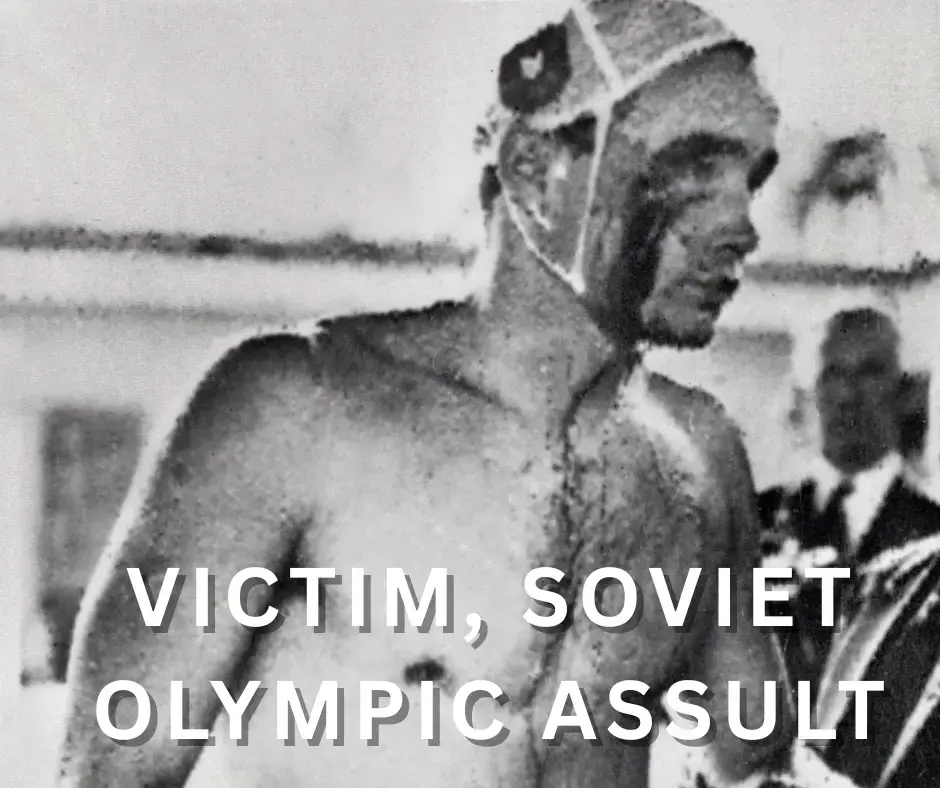
One of the most dramatic and political moments in Olympic history did not happen on a running track or a boxing ring, but in a swimming pool. The “Blood in the Water,” water polo match at the 1956 Melbourne Olympic Games became a symbol of political tension, national pride, and the dark side of international sport.
A World on Edge
In October 1956, just weeks before the Olympics began, Hungary rose up against its Iron Curtain Soviet control, attempting to break free from years of Soviet domination.
Initially the uprising looked hopeful, believing they’d won their freedom. But in early November, the Soviet Union sent tanks back into Hungary and crushed the revolution. Thousands of Hungarians were killed, and many more fled the country.
The Hungarian Olympic team was training in adjoining country during the uprising and subsequent Soviet slaughter, and because of severe censorship, the team only learned of the invasion through the Australian media. Athletes didn’t know if their families were safe and emotions were high. Especially among the Hungarian water polo team.
Hungary vs. the Soviet Union
The previous Olympic champions, the Hungarian team was highly skilled, disciplined, and proud. They expected to win gold.
The competition draw had Hungary and the Soviet Union playing each other in the semifinals. For the Hungarians, this was no longer just a game, but a chance to confront the country that had invaded their homeland.
On December 6, 1956 the large and emotionally charged crowd included many Hungarian refugees who’d escaped to Australia. They filled the stands, waving Hungarian flags and shouting angrily at the Soviet team.
A Brutal Match
The game was extremely rough from the first whistle. A very physical sport, much is played underwater away from the referee’s vision.
The Hungarian team used their superior skill to control the game as players punched, kicked, grabbed, and pulled each other beneath the surface, the tension continually rising. Every Hungarian goal was celebrated wildly by the crowd, while every Soviet possession was met with scorn.
By the second half, Hungary was ahead 4–0. The Soviet’s frustration magnified and violence escalated.
The Moment That Shocked the World
With just minutes remaining, a Soviet player struck a Hungarian in the face, blood pouring from a deep cut near his eye when he surfaced, staining the water red.
The crowd erupted in fury. Spectators shouted threats while others climbed over barriers to attack the Soviet players. As officials feared a riot, the referees ended the match to prevent further violence. Hungary was declared the winner, advancing to the final.
Photographs of the Hungarian player’s bloodied face were published around the world, leading to the match’s lasting “Blood in the Water” name.
Aftermath and Legacy
Hungary went on to win the gold medal, one of the proudest moments in the country’s sporting history, a victory that felt like an act of revenge and resistance against Soviet oppression.
Fearing punishment on their return, many Hungarian athletes defected, including the assaulted polo player, beginning new lives in countries like Australia and the United States.
The match became a powerful symbol of how sports and politics collide, showing that athletes carry their nations, histories, and emotions with them into competition.
Why It Still Matters
The “Blood in the Water” match is remembered not because of brilliant tactics or beautiful goals, but because of what it represented. It was a moment when the Olympic ideal of peaceful competition was overwhelmed by real-world conflict.
More than half a century later, the match remains one of the most famous and disturbing events in Olympic history, reminding us that sport can reflect deep political struggles, and that sometimes, a game is more than just a game.
With Russia the modern-day equivalent to the Soviet Union, their recent invasion of Ukraine makes the story is particularly poignant.
Part of a Story
The “Blood in the Water” match plays a key role in an early chapter of the action-adventure saga Outback Danger. Witnessing this dramatic event introduces Pam Forbes to the realities of the Hungarian Soviet occupation and its effect on Marton Landor, a refugee who makes such an impact on her life when they meet in Central Australia.
The book is one of William Sims’ Outback Adventures novels.
 Outback Danger novel: https://www.williamsimsbooks.com/outbackdanger
Website: https://www.williamsimsbooks.com/
"BLOOD IN THE WATER"THE MOST INFAMOUS MATCH IN OLYMPIC HISTORY